
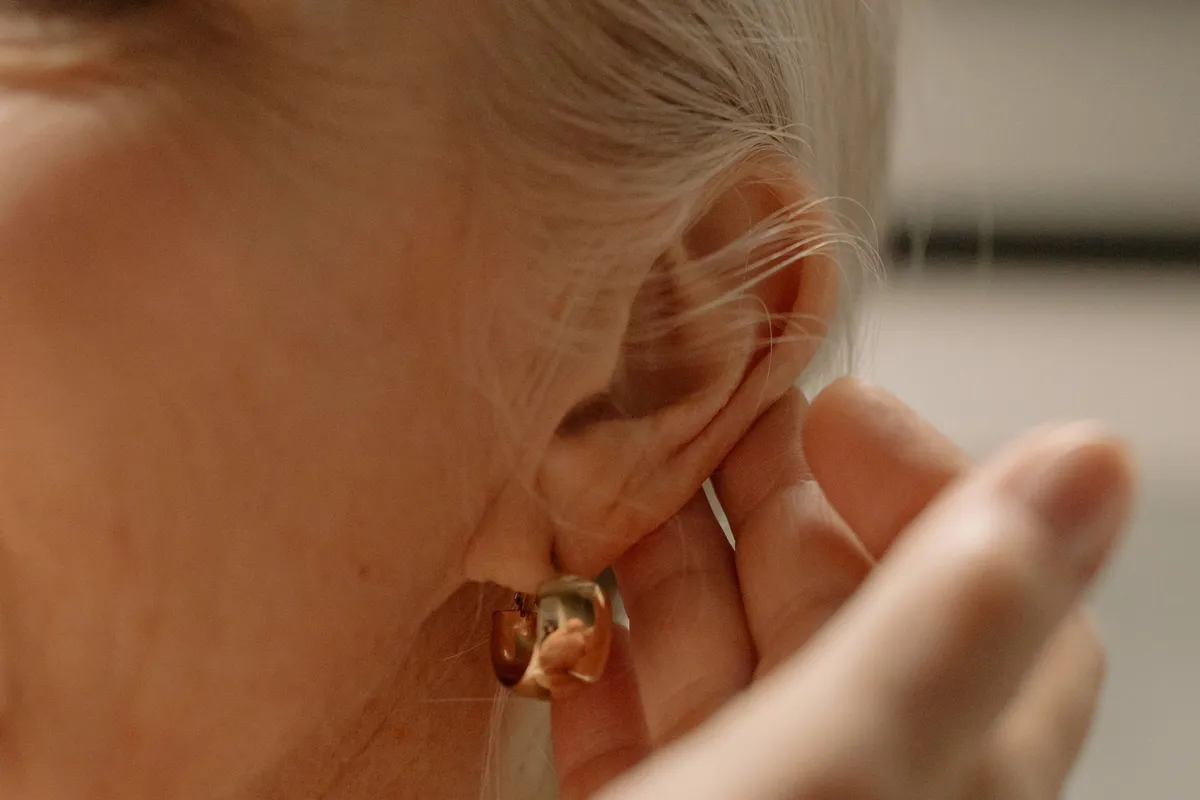
You are reading in a quiet room and there it is again: a thin ring, a hiss or a hum that nobody else can hear. After 50 it is natural to wonder whether it is just age, something you ate last week or a sign of something bigger.
I am no doctor, so I turned to the National Institute on Deafness and Other Communication Disorders (NIDCD), the US part of the US National Institutes of Health, to see what it says. Below you will find the most common causes after 50, the signs I would not wait on, a few daily habits for calmer evenings and where an ear-support supplement can fit once the doctor question is settled.
What Is Ringing in the Ears?
The medical name is tinnitus. The NIDCD describes it as the perception of a sound that has no outside source, so other people cannot hear it. Ringing is the classic version, but some people hear roaring, buzzing, whistling, humming, clicking or hissing. It can be soft or loud, high or low, constant or on and off.
It is more common than most of us think: surveys estimate that 10 to 25% of adults have it. For many people it improves or even goes away over time, although in some cases it gets worse, and when it lasts three months or longer it is called chronic. One more line from the NIDCD that I found calming: tinnitus is only rarely associated with a serious medical problem. The same page is honest that it can affect mood, sleep and concentration, which is reason enough to take it seriously.

What Are the Most Common Causes of Ringing in the Ears After 50?
The NIDCD says the exact causes are not fully understood, but it links tinnitus to a handful of everyday things. These are the ones I would look at first:
- Hearing changes with age. Hearing loss, which can come from aging or loud noise, is strongly associated with tinnitus, and most people who have tinnitus have some degree of it. The NIDCD adds that about one in three Americans between 65 and 74 has hearing loss.
- Noise, past and present. Loud workplaces, concerts and sports events are on the NIDCD list, and so are headphones or earbuds used at high volume.
- Earwax or an ear infection. A blocked ear canal, whether from wax or from fluid after an infection, can trigger ringing, which is why a first visit often starts with a simple look in the ear.
- Certain medicines. Some pain relievers, antibiotics and antidepressants, among others, can cause tinnitus, especially at high doses. If you take any of them, mention it to your doctor.
- Jaw, neck and head. The jaw joint sits right next to the ear, and the NIDCD says clenching or grinding can cause or worsen tinnitus. A head or neck injury can be behind it too.
- Blood vessels and everyday conditions. High blood pressure and atherosclerosis can change blood flow near the ear, and diabetes, migraines, thyroid disorders and anemia are among the chronic conditions linked to tinnitus. My articles on cholesterol after menopause and blood sugar after 50 cover two of those areas.
Some people develop tinnitus for no known reason at all, and that is common too.
When Should You See a Doctor About Ringing in the Ears?
Most ringing is not an emergency, but a few signs are the ones I would not wait on:
- Sudden hearing loss, with or without ringing. The NIDCD calls sudden deafness a medical emergency and says to see a doctor right away. It most often affects adults in their late 40s and early 50s, and although about half of people recover some or all of their hearing on their own, waiting can make treatment less effective.
- A sound that beats with your pulse. The NIDCD says this rare kind often has an identifiable cause and is treatable, so it is worth mentioning.
- Ringing with dizziness or balance trouble. Ménière's disease, an inner ear disorder, can cause tinnitus along with balance problems and hearing loss.
- Ringing after a head or neck injury. An injury can affect the ear, the nerve that carries sound or the part of the brain that processes it.
- Ringing that stays or wears you down. Three months or more counts as chronic, and if it is hurting your sleep, mood or focus, that is reason enough to book a visit.

What does the visit look like?
The NIDCD says to start with your primary care doctor, who will check for earwax or fluid from an ear infection and ask about your medical history and the medicines you take. You may then be referred to an ear, nose and throat doctor (ENT) and an audiologist, who can measure your hearing. I would go in with a few notes: which ear, when it started, what it sounds like and what seems to make it louder.
What Can You Do Every Day for Quieter Evenings?
None of these replace an appointment, and all of them are gentle. Here is what I would start with:
- Protect your ears from loud noise. The NIDCD suggests avoiding loud sounds, shortening the time you spend near them and wearing earplugs or earmuffs around lawn mowers, leaf blowers and similar tools. Keep headphones at a comfortable volume.
- Give the night a soft background sound. For mild tinnitus, the NIDCD says a sound machine, a phone app with rain or waves, a radio or even a household fan near the bed may be all you need to fall asleep.
- Wind down before bed. A quiet routine helps the ringing feel less loud. My guide to waking up at 3 a.m. has simple evening ideas.
- Notice your jaw. If you clench when you are tense, drop your shoulders and let your teeth part. The NIDCD links clenching and grinding to tinnitus.
- Keep a small note. A line a day about when it is louder, such as after a noisy outing or a bad night, helps you spot patterns and gives your doctor something concrete to work with.
Ringing also makes it harder to focus, and my article on memory support basics after 50 has everyday habits for that. The wider picture of aging well is in my healthy aging guide.

Where Can an Ear-Support Supplement Fit In?
Tinnitus has no cure today, so nothing on this page promises one. Some readers still like to add a daily supplement made for ear comfort as one more easy step once a doctor has looked at the ringing. These are the two I review on Primaurea, in two different forms so you can pick the one that suits your routine.
Zeneara: a once-daily capsule with eight named ingredients

Zeneara is a vegan capsule you take once a day, with every ingredient named on the official page: two probiotic strains (Lactobacillus paracasei and Lactobacillus brevis), taurine, Maidenhair Tree (ginkgo), valerian, passion flower, zinc and vitamin B6. It is non-GMO, made in an FDA-registered, GMP-certified facility and marketed as everyday support for ear comfort and calm. I go through it in my Zeneara review.
On the official page on October 30, 2026, one bottle (a 30-day supply) was $59, three bottles were $147 ($49 each) and six bottles were $234 ($39 each), all with free US shipping, and every order is covered by a 365-day money-back guarantee.
ZenCortex: a twice-daily liquid dropper

ZenCortex is a liquid you take with a dropper, one before breakfast and one before lunch, under the tongue or stirred into a glass of water or natural juice. It brings together over 20 plant and nutrient ingredients, including grape seed, green tea, Panax ginseng, astragalus, maca and chromium, and it is made in the USA and labeled to support healthy hearing. One bottle lasts 30 days. The details are in my ZenCortex review.
On the official order page on October 30, 2026, two bottles were $158 ($79 each, plus shipping), three bottles were $207 ($69 each) and six bottles were $294 ($49 each), with free US shipping on three and six bottles. It is a one-time payment with a 60-day money-back guarantee.
Zeneara is the simpler fit if you prefer one capsule a day, and ZenCortex is the one to look at if you would rather take a liquid. As the official Zeneara and ZenCortex pages advise, ask your doctor first if you take medication, are pregnant or nursing, or have a medical condition.
Prices are in US dollars, as listed on the official sites on October 30, 2026, and may change.
Ringing in the Ears After 50: What I Would Do
Ringing in the ears after 50 is common, it often traces back to hearing changes, noise, earwax or medicines, and it is only rarely serious. I would first rule out the signs that cannot wait, then protect my ears, add a soft sound at night and look after my sleep.
If you want one daily ear-support step on top, Zeneara is the capsule and ZenCortex is the liquid. Both are described as support, never as a cure, and both link to the official site above.
Frequently Asked Questions
Is ringing in the ears normal after 50?
It is common. The NIDCD says surveys estimate that 10 to 25% of adults have tinnitus, and hearing loss, which becomes more common with age, is strongly associated with it. It is only rarely linked to a serious medical problem, but sudden hearing loss, a sound that beats with your pulse or ringing with dizziness is a reason to see a doctor soon.
What causes ringing in the ears in older adults?
The NIDCD links tinnitus to hearing loss, loud noise, certain medicines, earwax or an ear infection, head or neck injuries, jaw joint problems, high blood pressure and atherosclerosis, and chronic conditions such as diabetes, migraines, thyroid disorders and anemia. Some people have no known cause.
When should I see a doctor for ringing in my ears?
See a doctor right away for sudden hearing loss, which the NIDCD calls a medical emergency. I would also book a visit for a sound that beats with your pulse, ringing with dizziness or balance trouble, ringing after a head or neck injury, or ringing that lasts three months or more or disturbs your sleep and mood.
Can ringing in the ears go away on its own?
For adults and children, the NIDCD says tinnitus may improve or even go away over time, although in some cases it worsens. When there is an underlying cause, such as earwax, addressing it can eliminate or greatly reduce the symptoms.
Can earwax or medicines cause ringing in the ears?
Yes. The NIDCD says blockage of the ear canal by earwax or fluid from an ear infection can trigger tinnitus, and that tinnitus can be a side effect of certain medicines, especially at high doses. Tell your doctor which medicines you take.
Is there a cure for tinnitus?
The NIDCD says there is currently no cure for tinnitus, although there are ways to reduce symptoms. That is why the supplements on this page are described as everyday support for ear comfort and never as a cure.
What is Zeneara and how do I take it?
Zeneara is a vegan capsule taken once a day, with eight named ingredients: Lactobacillus paracasei, Lactobacillus brevis, taurine, Maidenhair Tree (ginkgo), valerian, passion flower, zinc and vitamin B6. On October 30, 2026, the official page listed $59 for one bottle, $147 for three and $234 for six, all with free US shipping and a 365-day money-back guarantee.
What is ZenCortex and how do I take it?
ZenCortex is a liquid with over 20 plant and nutrient ingredients, taken with a dropper before breakfast and again before lunch, under the tongue or in water or juice. On October 30, 2026, the official page listed $158 for two bottles (plus shipping), $207 for three and $294 for six, with free US shipping on three and six, a one-time payment and a 60-day money-back guarantee.
Statements about dietary supplements on this page have not been evaluated by the Food and Drug Administration. This product is not intended to diagnose, treat, cure or prevent any disease.
Photos: cottonbro studio (cover, tea and headphones) and Vitaly Gariev (doctor's office), on Pexels.